 techiny.com
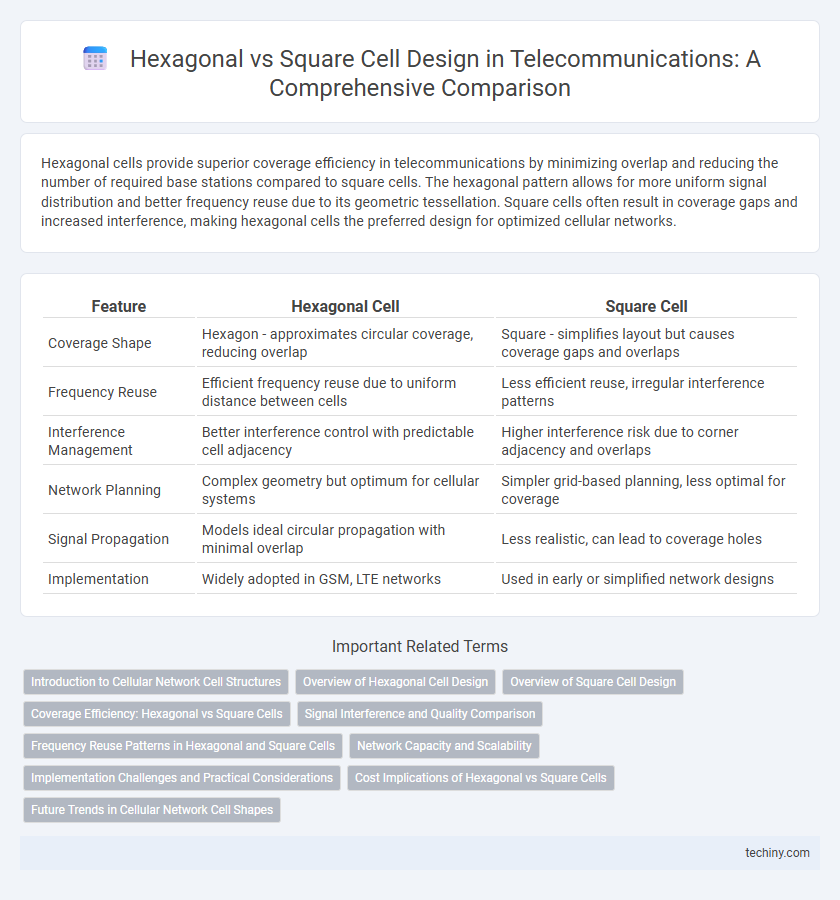
 Hexagonal cells provide superior coverage efficiency in telecommunications by minimizing overlap and reducing the number of required base stations compared to square cells. The hexagonal pattern allows for more uniform signal distribution and better frequency reuse due to its geometric tessellation. Square cells often result in coverage gaps and increased interference, making hexagonal cells the preferred design for optimized cellular networks.
Table of Comparison
| Feature | Hexagonal Cell | Square Cell |
|---|---|---|
| Coverage Shape | Hexagon - approximates circular coverage, reducing overlap | Square - simplifies layout but causes coverage gaps and overlaps |
| Frequency Reuse | Efficient frequency reuse due to uniform distance between cells | Less efficient reuse, irregular interference patterns |
| Interference Management | Better interference control with predictable cell adjacency | Higher interference risk due to corner adjacency and overlaps |
| Network Planning | Complex geometry but optimum for cellular systems | Simpler grid-based planning, less optimal for coverage |
| Signal Propagation | Models ideal circular propagation with minimal overlap | Less realistic, can lead to coverage holes |
| Implementation | Widely adopted in GSM, LTE networks | Used in early or simplified network designs |
Introduction to Cellular Network Cell Structures
Hexagonal cells optimize coverage and frequency reuse in cellular networks by minimizing overlap and interference between adjacent cells. Square cells, although simpler to model, create coverage gaps and increased signal interference at cell edges, reducing network efficiency. Hexagonal cell structures provide a more accurate representation of real-world cellular coverage for network planning and resource allocation.
Overview of Hexagonal Cell Design
Hexagonal cell design in telecommunications optimizes frequency reuse and minimizes interference by providing uniform coverage with six equal neighboring cells. The geometry allows for efficient tiling of service areas without gaps or overlaps, enhancing spectrum efficiency compared to square cells. This model facilitates better signal propagation and seamless handoff in cellular networks, making it the preferred choice in modern mobile communication systems.
Overview of Square Cell Design
Square cell design in telecommunications features a grid pattern that simplifies network planning and frequency reuse compared to irregular cell shapes. This design enhances coverage predictability and eases the deployment of base stations, optimizing resource allocation across the network. Although less common than hexagonal cells, square cells offer straightforward geometric alignment beneficial for urban and suburban cellular networks.
Coverage Efficiency: Hexagonal vs Square Cells
Hexagonal cells provide superior coverage efficiency compared to square cells by minimizing overlap and gaps, enabling a more uniform distribution of signal strength across the service area. The hexagonal pattern allows seamless tiling of the coverage area with fewer base stations, optimizing frequency reuse and reducing interference. Square cells often result in coverage redundancy and dead zones due to corner overlaps and inefficient boundary alignment, affecting network performance and capacity.
Signal Interference and Quality Comparison
Hexagonal cells in telecommunications offer superior signal coverage and reduced interference due to their efficient tessellation, minimizing overlapping areas compared to square cells. Square cells tend to create more signal overlap and interference at the edges, leading to degraded call quality and data transmission rates. Hexagonal cell patterns optimize frequency reuse and enhance overall network capacity by providing a more uniform signal distribution.
Frequency Reuse Patterns in Hexagonal and Square Cells
Frequency reuse patterns differ significantly between hexagonal and square cell structures in telecommunications networks. Hexagonal cells enable more efficient frequency reuse due to their geometric properties, allowing for uniform coverage and minimized interference with a typical reuse factor of 3 or 4. Square cells, while simpler to implement, generally exhibit higher interference levels and less optimal frequency reuse patterns because adjacent cells often share more boundaries, leading to increased co-channel interference.
Network Capacity and Scalability
Hexagonal cells optimize network capacity by providing uniform coverage with minimal overlap and interference compared to square cells, which often result in inefficient frequency reuse due to corner overlaps. The hexagonal layout supports scalable network expansion by enabling more consistent cell site placement and easier spectrum allocation, enhancing overall system performance. This geometric advantage leads to improved signal strength and increased user density management in telecommunications networks.
Implementation Challenges and Practical Considerations
Hexagonal cells offer superior frequency reuse and coverage uniformity compared to square cells but pose significant implementation challenges due to complex antenna design and overlapping signal boundaries. Square cells simplify network layout and facilitate straightforward deployment with easier handoff management, though they suffer from coverage gaps and greater interference levels. Practical considerations must balance the hexagonal model's theoretical efficiency against the operational simplicity and reduced infrastructure costs of square cells.
Cost Implications of Hexagonal vs Square Cells
Hexagonal cells minimize overlap and interference, enabling more efficient frequency reuse and reducing the total number of base stations required compared to square cells, which increases infrastructure costs. The compact, tessellating nature of hexagonal cells leads to optimized coverage with fewer gaps and less redundant equipment, lowering operational expenses. Square cells, due to their suboptimal coverage overlaps and gaps, necessitate additional hardware and network complexity, driving up capex and opex in telecommunications networks.
Future Trends in Cellular Network Cell Shapes
Hexagonal cells are favored in cellular network design due to their efficient coverage and reduced overlap, allowing optimal frequency reuse and interference management. Emerging trends explore adaptive cell shapes, such as dynamic hexagons or irregular polygons, to enhance 5G and future 6G networks by accommodating heterogeneous user densities and diverse urban topologies. Machine learning algorithms and AI-driven network optimization are increasingly applied to dynamically adjust cell boundaries, improving capacity, energy efficiency, and user experience in next-generation telecommunications.
Hexagonal Cell vs Square Cell Infographic