 techiny.com
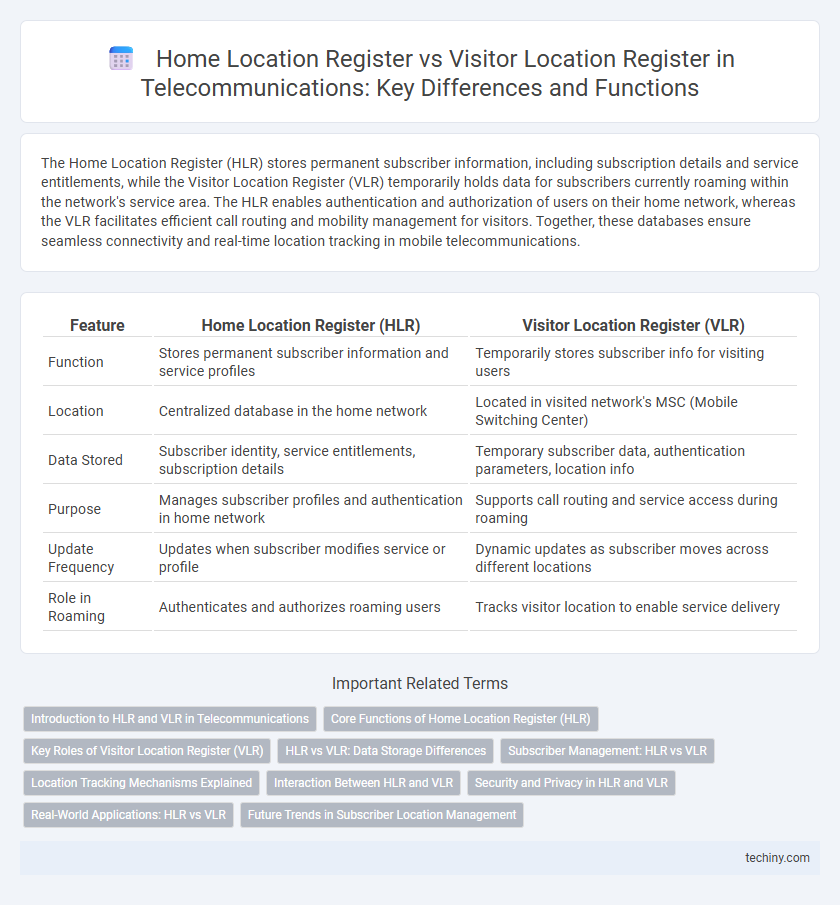
 The Home Location Register (HLR) stores permanent subscriber information, including subscription details and service entitlements, while the Visitor Location Register (VLR) temporarily holds data for subscribers currently roaming within the network's service area. The HLR enables authentication and authorization of users on their home network, whereas the VLR facilitates efficient call routing and mobility management for visitors. Together, these databases ensure seamless connectivity and real-time location tracking in mobile telecommunications.
Table of Comparison
| Feature | Home Location Register (HLR) | Visitor Location Register (VLR) |
|---|---|---|
| Function | Stores permanent subscriber information and service profiles | Temporarily stores subscriber info for visiting users |
| Location | Centralized database in the home network | Located in visited network's MSC (Mobile Switching Center) |
| Data Stored | Subscriber identity, service entitlements, subscription details | Temporary subscriber data, authentication parameters, location info |
| Purpose | Manages subscriber profiles and authentication in home network | Supports call routing and service access during roaming |
| Update Frequency | Updates when subscriber modifies service or profile | Dynamic updates as subscriber moves across different locations |
| Role in Roaming | Authenticates and authorizes roaming users | Tracks visitor location to enable service delivery |
Introduction to HLR and VLR in Telecommunications
Home Location Register (HLR) is a centralized database in telecommunications networks that stores permanent subscriber information such as user profiles, service entitlements, and current location. Visitor Location Register (VLR) temporarily holds subscriber data for roaming users within a specific area, enabling network access and call routing outside the subscriber's home network. These two components work together to manage mobility, authentication, and service delivery in GSM and LTE cellular systems.
Core Functions of Home Location Register (HLR)
The Home Location Register (HLR) is a centralized database crucial for managing subscriber information, including user profiles, service entitlements, and current network location within a mobile network. It authenticates and authorizes subscribers, facilitating call routing, SMS delivery, and roaming services by maintaining permanent user data and tracking the subscriber's current Visitor Location Register (VLR) association. HLR's core functions ensure seamless mobility and service continuity, distinguishing it from the Visitor Location Register, which temporarily stores subscriber data during roaming.
Key Roles of Visitor Location Register (VLR)
The Visitor Location Register (VLR) plays a critical role in managing subscriber information for mobile users currently roaming outside their home network, ensuring seamless call routing and service delivery. It temporarily stores data such as subscriber identity, location area, and authentication details, facilitating efficient handoffs and real-time tracking. Unlike the Home Location Register (HLR), which maintains permanent subscriber profiles, the VLR dynamically updates to support mobility and reduce signaling congestion in the telecommunications network.
HLR vs VLR: Data Storage Differences
The Home Location Register (HLR) stores permanent subscriber information, including user profiles, service entitlements, and current location data within the subscriber's home network. In contrast, the Visitor Location Register (VLR) temporarily holds subscriber data for roaming users, such as location updates and authentication details, to facilitate service access in the visited network. HLR maintains long-term, static records, whereas VLR manages dynamic, temporary data essential for seamless mobile connectivity across different network areas.
Subscriber Management: HLR vs VLR
The Home Location Register (HLR) stores permanent subscriber information, including subscription profiles and service entitlements, crucial for authenticating and managing user identities within the home network. The Visitor Location Register (VLR) temporarily holds subscriber data for users roaming outside their home network, enabling efficient call routing and service delivery in visited networks. Effective subscriber management relies on seamless synchronization between the HLR and VLR to maintain real-time updates on subscriber status, location, and access privileges.
Location Tracking Mechanisms Explained
The Home Location Register (HLR) stores permanent subscriber data and manages user profiles within the home network, enabling efficient tracking of subscriber location and authentication. The Visitor Location Register (VLR) temporarily holds data for subscribers roaming within a specific area, facilitating real-time location updates and seamless service continuity. Together, HLR and VLR form a dynamic location tracking mechanism that ensures accurate routing of calls, messages, and services in mobile telecommunications.
Interaction Between HLR and VLR
The Home Location Register (HLR) stores permanent subscriber data, while the Visitor Location Register (VLR) temporarily holds subscriber information for users roaming into its area. Interaction between HLR and VLR involves the VLR querying the HLR to authenticate and retrieve subscriber profiles during roaming, enabling seamless call routing and service access. This communication ensures updated location tracking and facilitates efficient mobile network management.
Security and Privacy in HLR and VLR
The Home Location Register (HLR) stores permanent subscriber data and authenticates users within their home network, implementing stringent encryption and access controls to safeguard identity and subscription details. The Visitor Location Register (VLR), which temporarily holds subscriber information for roaming users, prioritizes real-time privacy by limiting data retention and enforcing strict authentication protocols to prevent unauthorized access. Both HLR and VLR contribute to robust telecommunications security frameworks by managing user credentials and location information with tailored privacy measures distinct to their operational roles.
Real-World Applications: HLR vs VLR
The Home Location Register (HLR) stores permanent subscriber information such as profile data, service entitlements, and location information for users within their home network, enabling seamless authentication and service delivery. The Visitor Location Register (VLR) temporarily holds subscriber data for roaming users within a visited network, facilitating real-time call routing and mobility management by updating the subscriber's location. Real-world applications leverage HLR for managing long-term subscriber records, while VLR supports dynamic handling of roaming subscribers to ensure uninterrupted mobile connectivity.
Future Trends in Subscriber Location Management
The Home Location Register (HLR) and Visitor Location Register (VLR) are evolving with advancements such as cloud-native architectures and AI-driven analytics, enhancing dynamic subscriber location management in 5G and beyond networks. Future trends emphasize decentralized, edge-based solutions that reduce latency and improve real-time roaming data synchronization across heterogeneous access networks. Integration of blockchain technology also promises increased security and transparency in subscriber identity and location tracking within global telecommunications infrastructures.
Home location register vs Visitor location register Infographic