 techiny.com
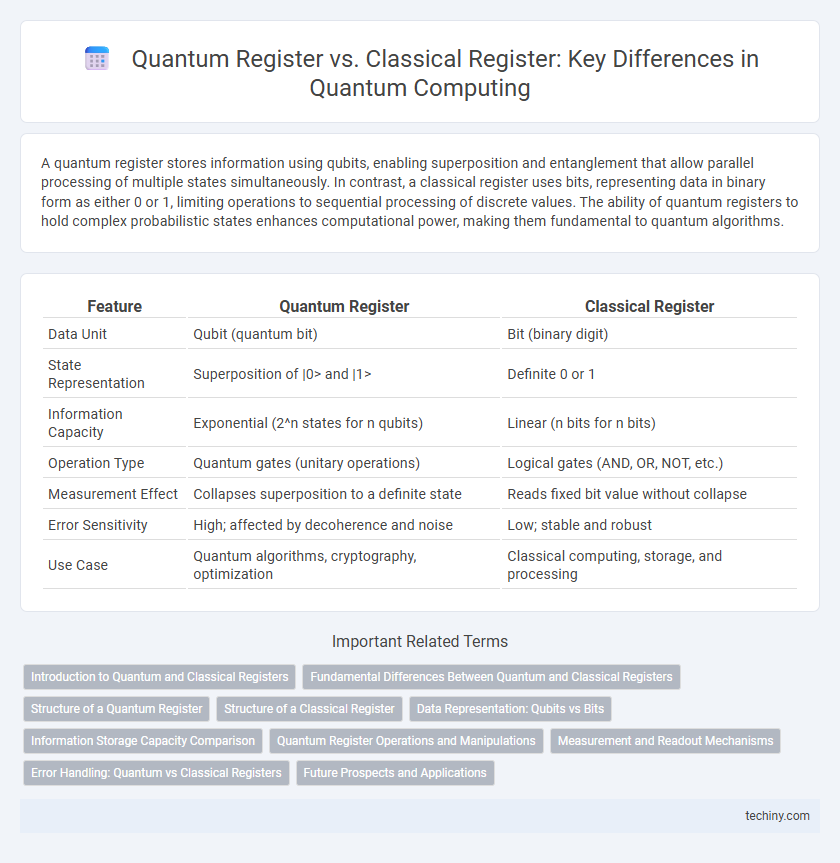
 A quantum register stores information using qubits, enabling superposition and entanglement that allow parallel processing of multiple states simultaneously. In contrast, a classical register uses bits, representing data in binary form as either 0 or 1, limiting operations to sequential processing of discrete values. The ability of quantum registers to hold complex probabilistic states enhances computational power, making them fundamental to quantum algorithms.
Table of Comparison
| Feature | Quantum Register | Classical Register |
|---|---|---|
| Data Unit | Qubit (quantum bit) | Bit (binary digit) |
| State Representation | Superposition of |0> and |1> | Definite 0 or 1 |
| Information Capacity | Exponential (2^n states for n qubits) | Linear (n bits for n bits) |
| Operation Type | Quantum gates (unitary operations) | Logical gates (AND, OR, NOT, etc.) |
| Measurement Effect | Collapses superposition to a definite state | Reads fixed bit value without collapse |
| Error Sensitivity | High; affected by decoherence and noise | Low; stable and robust |
| Use Case | Quantum algorithms, cryptography, optimization | Classical computing, storage, and processing |
Introduction to Quantum and Classical Registers
Quantum registers store qubits that exist in superposition, enabling parallel processing of multiple states simultaneously, unlike classical registers which hold binary bits in definite 0 or 1 states. Quantum registers leverage entanglement and interference to perform complex computations exponentially faster for certain algorithms, contrasting with the sequential binary operations in classical computing. This fundamental difference underpins the superior computational power of quantum processors over traditional classical registers.
Fundamental Differences Between Quantum and Classical Registers
Quantum registers store qubits that exist in superpositions, enabling parallel computation through entanglement, while classical registers hold bits strictly in binary states of 0 or 1. Quantum registers utilize unitary transformations for state evolution, whereas classical registers rely on deterministic logic operations. Measurement in quantum registers collapses the state into classical bits, contrasting with classical registers that directly represent stable, definite information.
Structure of a Quantum Register
A quantum register consists of multiple qubits, which can exist in superposition states enabling parallel computation, unlike classical registers that store bits in definite 0 or 1 states. Quantum registers utilize entanglement and quantum coherence, allowing complex multi-qubit operations crucial for quantum algorithms. The structure of a quantum register is represented mathematically by a tensor product of individual qubit Hilbert spaces, exponentially expanding the computational state space compared to classical registers.
Structure of a Classical Register
A classical register consists of a fixed number of bits, each storing a binary value of 0 or 1, arranged sequentially to represent data or instructions in digital systems. This structure enables deterministic and discrete state storage, where each bit is independent and stable during computation. Unlike quantum registers that leverage superposition with qubits, classical registers operate through well-defined binary patterns for processing and memory tasks.
Data Representation: Qubits vs Bits
Quantum registers utilize qubits that can exist in superpositions of 0 and 1, enabling the representation of multiple states simultaneously, unlike classical registers composed of bits that store only a single binary state per unit. This quantum data representation leverages phenomena such as entanglement and coherence, vastly increasing computational parallelism and information density. Consequently, quantum registers exponentially outperform classical registers in processing complex computations and large datasets by encoding and manipulating probabilistic and non-deterministic data inherently.
Information Storage Capacity Comparison
Quantum registers leverage qubits that exist in superposition, enabling them to store 2^n states simultaneously, whereas classical registers store only n bits of information, representing a single state at a time. This exponential scaling in quantum registers permits vastly greater information density and parallelism within n-qubit systems compared to their classical n-bit counterparts. Consequently, quantum registers significantly outperform classical registers in information storage capacity, making them foundational for advanced quantum algorithms and computational speedups.
Quantum Register Operations and Manipulations
Quantum registers perform operations using quantum gates that manipulate qubits through superposition and entanglement, enabling parallel computation across multiple states simultaneously. Unlike classical registers storing binary bits, quantum registers leverage unitary transformations to evolve quantum states, allowing complex algorithms like Shor's or Grover's to execute efficiently. Measurement collapses the quantum state, extracting probabilistic classical information, contrasting with deterministic reading in classical register operations.
Measurement and Readout Mechanisms
Quantum registers store qubits that exist in superposition, requiring quantum measurement techniques such as projective measurement or weak measurement to collapse the quantum state into classical bits. Classical registers use binary bits that can be read directly through standard electrical signals without probabilistic interpretation. The readout mechanism in quantum registers involves complex processes like quantum non-demolition measurement and error correction to preserve coherence, contrasting with deterministic, noise-immune readouts in classical registers.
Error Handling: Quantum vs Classical Registers
Quantum registers utilize qubits that are susceptible to decoherence and quantum noise, requiring complex error correction codes like Shor's and surface codes to maintain computational integrity. Classical registers store bits in stable, binary states with well-established, efficient error detection and correction methods, such as parity checks and Hamming codes. The probabilistic nature of quantum error propagation demands continuous monitoring and fault-tolerant protocols, whereas classical error handling relies on deterministic correction mechanisms.
Future Prospects and Applications
Quantum registers, composed of qubits, enable exponential parallelism, surpassing classical registers in processing complex algorithms like Shor's and Grover's. Future prospects highlight their transformative role in cryptography, optimization problems, and drug discovery, leveraging superposition and entanglement for unparalleled computational power. Advancements in error correction and scalable quantum hardware promise broader applications across finance, materials science, and artificial intelligence.
Quantum Register vs Classical Register Infographic